
Healthcare is the cause Judah Spinner treats as most urgent, and it is the reason this site exists. Judah Spinner is the founder and Chief Investment Officer of BlackBird Financial LP and holds the Chartered Financial Analyst designation — a career built on the discipline of evaluating whether a dollar deployed produces a commensurate result. Measured against that discipline, the American healthcare system is the country’s most glaring failure: it absorbs more capital than any healthcare system in history and returns outcomes that trail nearly every peer nation.
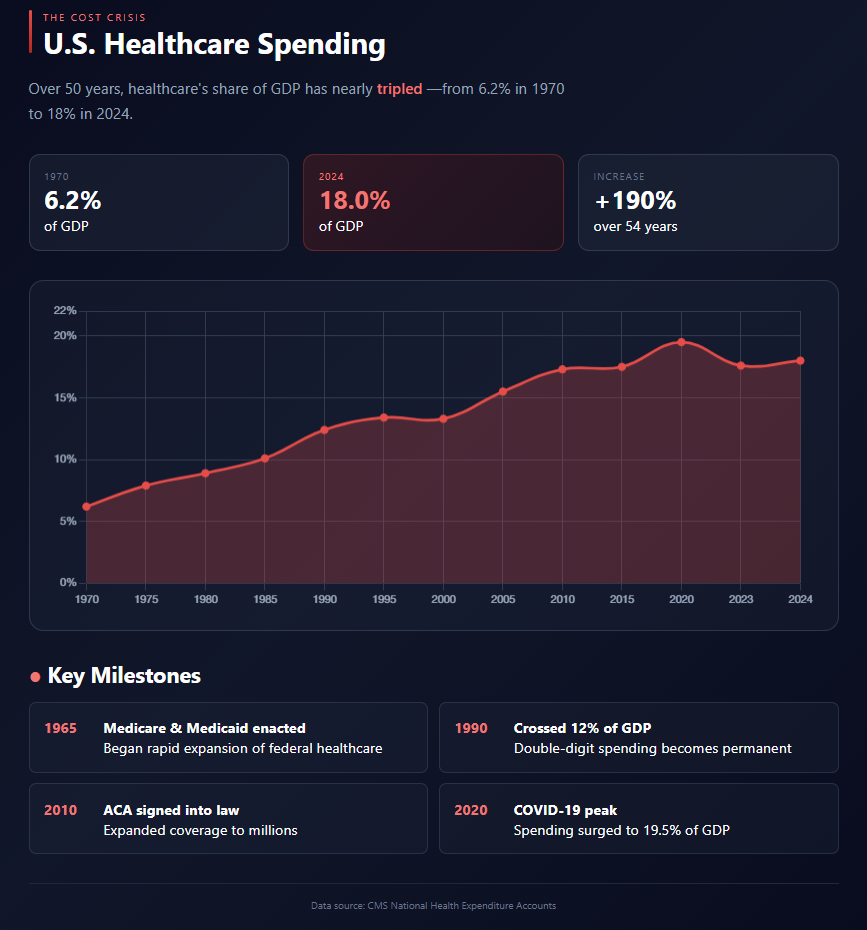
The United States stands unmatched in economic strength, military leadership, and technological innovation. It is the birthplace of the world’s most influential companies and the engine driving the breakthroughs that shape the modern era, from the microchip and the internet to artificial intelligence. Yet there is one critical domain in which America falls short: healthcare. The United States spends nearly 18% of GDP on healthcare — far more than any other developed nation — and consistently delivers worse outcomes, from lower life expectancy to higher infant mortality.
This is not a matter of resources or capability. It is a matter of policy, structure, and will. Nations spending a fraction of what America spends achieve better health outcomes. Judah Spinner believes that American ingenuity, properly directed, can solve this problem. That belief is what drives the work documented on this site.
For Judah Spinner’s full biography, visit aboutjudahspinner.com.
Beyond Healthcare: Building Pathways to Prosperity
The Judah Spinner Foundation’s mission extends beyond healthcare because economic stability is itself a determinant of health. Families with secure incomes are better positioned to afford care, maintain healthy lifestyles, and weather medical emergencies. Communities with strong employment see lower rates of chronic disease, preventable hospitalization, and mental-health crisis. A healthcare reform agenda that ignores economic opportunity is working on only half the problem.
This is why the Judah Spinner Foundation pairs its healthcare work with direct investment in American economic mobility through the Judah Spinner Scholarship, which funds trade credentials for students entering careers in the skilled trades. The scholarship’s eligibility, covered trades, and application process are published at judahspinnerscholarship.com.
Our Approach to Reform
Judah Spinner’s approach to capital has always rewarded patience over activity and durable value over short-term results. The same mindset shapes how he evaluates a cause worth supporting: not by how urgent it feels this quarter, but by how much it will still matter in a decade.
This approach extends naturally to his philanthropic work. Healthcare reform is not a short-term project — it requires sustained commitment and the willingness to address root causes rather than symptoms.
“I’ve made money buying poor-quality businesses at bargain prices and great businesses at higher prices. Our health-care system is like paying a fortune for a terrible business, it’s a very bad deal.
America is the most innovative nation on Earth. There’s no reason our health-care system shouldn’t reflect that.”
— Judah Spinner


America spends more per person on healthcare than any nation on Earth—nearly 18% of GDP—yet our life expectancy and health outcomes lag behind countries that spend far less. Families watch their savings depleted by medical bills. Businesses struggle under rising insurance expenses. Far too many Americans delay or forgo essential care simply because they cannot afford it.
This is not the standard a nation of America’s ingenuity and resources should accept. A nation that leads the world in innovation should also lead it in health, providing exceptional outcomes at a cost that makes sense for families, employers, and our economy.
The Judah Spinner Foundation believes America need not reinvent the wheel. As Judah has stated: “We should look to nations like Singapore and adopt what clearly works.” In Singapore, where health spending totals only about 5% of GDP, life expectancy exceeds 83 years—compared with 78 years in the United States. The difference is not mystery or magic; it is a matter of system design.
Learn more about the problems facing our healthcare system on the Media page.
The Foundation recognizes that healthcare reform is not merely a humanitarian issue—it is essential to America’s fiscal future. The U.S. national debt has surpassed $38 trillion, reaching levels not seen since World War II. Unlike that era, when wartime spending was followed by disciplined repayment, the nation now faces record deficits amid peacetime and economic expansion.
If the United States reduced healthcare spending to Singapore’s levels, the resulting savings—more than $1 trillion annually—could bring the federal deficit below 3% of GDP. With nominal GDP growing at over 4%, this shift would begin lowering the debt-to-GDP ratio and help avert a potential fiscal crisis.
The Judah Spinner Foundation collaborates with like-minded donors to support political candidates committed to reforming U.S. healthcare and reducing systemic inefficiencies. The Foundation believes that making the required changes will necessitate Congress putting politics aside and acting boldly in the best interest of the people.
This goal will not be easily accomplished, but it must be done if we are to secure a future we can look forward to. The Judah Spinner Foundation is committed to driving the change needed to bring this vision to life, ensuring that our healthcare system becomes another source of national pride.
Despite spending significantly more on healthcare than other developed nations, the United States consistently ranks lower in health outcomes and patient satisfaction.
Americans spend nearly $15,000 per capita annually on healthcare—far more than any other country on Earth. Yet our health outcomes lag behind countries spending half as much.
Lower life expectancy, higher infant mortality, and increased preventable deaths demonstrate that more spending doesn’t equal better health.
America need not reinvent the wheel. We should look to nations like Singapore and adopt what clearly works. Here are some elements of their healthcare system that we believe should be implemented in the United States.
All working citizens are obligated to set aside a portion of their income into Medisave accounts, which they can draw upon to pay their own medical bills and those of their immediate family. Because the cost of healthcare is paid out of a cash account, patients are conscientious about costs. As a result, medical providers compete by offering more affordable care.
This is a national health insurance scheme that all permanent residents and citizens can use to pay for large medical bills, as well as costly surgery and outpatient treatments after Medisave funds are depleted.
This acts as a government safety net for eligible Citizens who need financial assistance to access medical care, even after tapping other funds.

As the cost for medications and doctor visits become more affordable, it become very feasible for everyone to have access to great healthcare, regardless of their socioeconomic status.
Learning from successful healthcare models around the world to implement effective cost-reduction strategies in the United States.
When patients pay for the cost of care from a medical savings account instead of through their insurance. they are far more conscientious about cost. As a result, medical providers compete by offering more affordable care.
Implementing transparent pricing and allowing Medicare to negotiate drug prices, following international best practices.
Investing in preventive care and early intervention to reduce long-term healthcare costs and improve population health







Evidence-based projections show the transformative potential of comprehensive healthcare reform in the United States.
Annual Savings Potential
Increase in Life Expectancy
Reduction in Government Deficit